Abundant raw material base
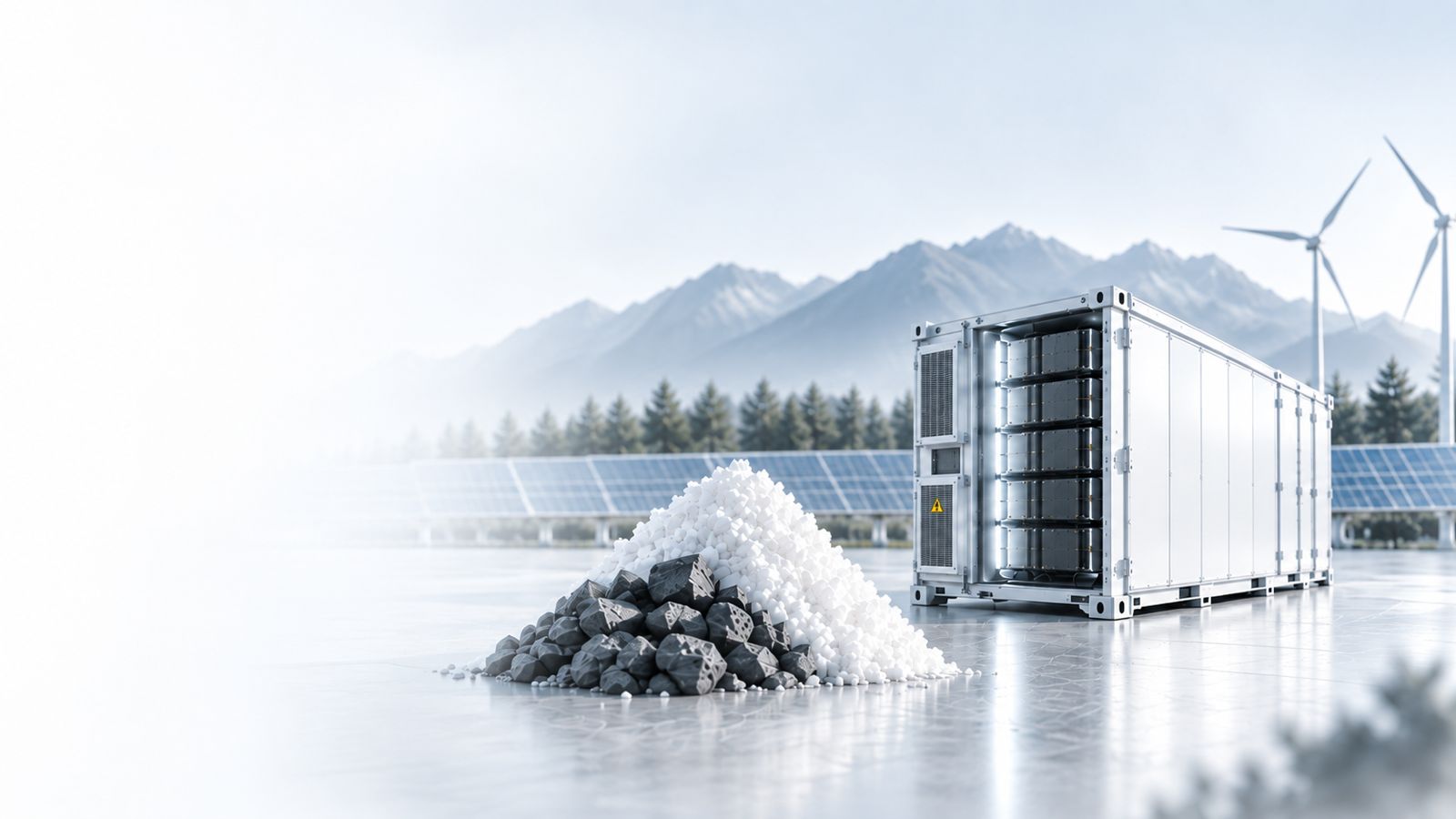
Sodium is widely available globally. That makes the chemistry strategically interesting where material accessibility and supply diversification matter.
SHAPE THE ENERGY TRANSITION
Demand for sustainable large-scale storage is booming. Find out how you can take part in the growth of sodium-ion technology.
Explore investment opportunities →Technology overview and market data by email — your details go only to us and our form system, Mautic.
Technical content is being expanded as validated project data becomes available.
TECHNOLOGY
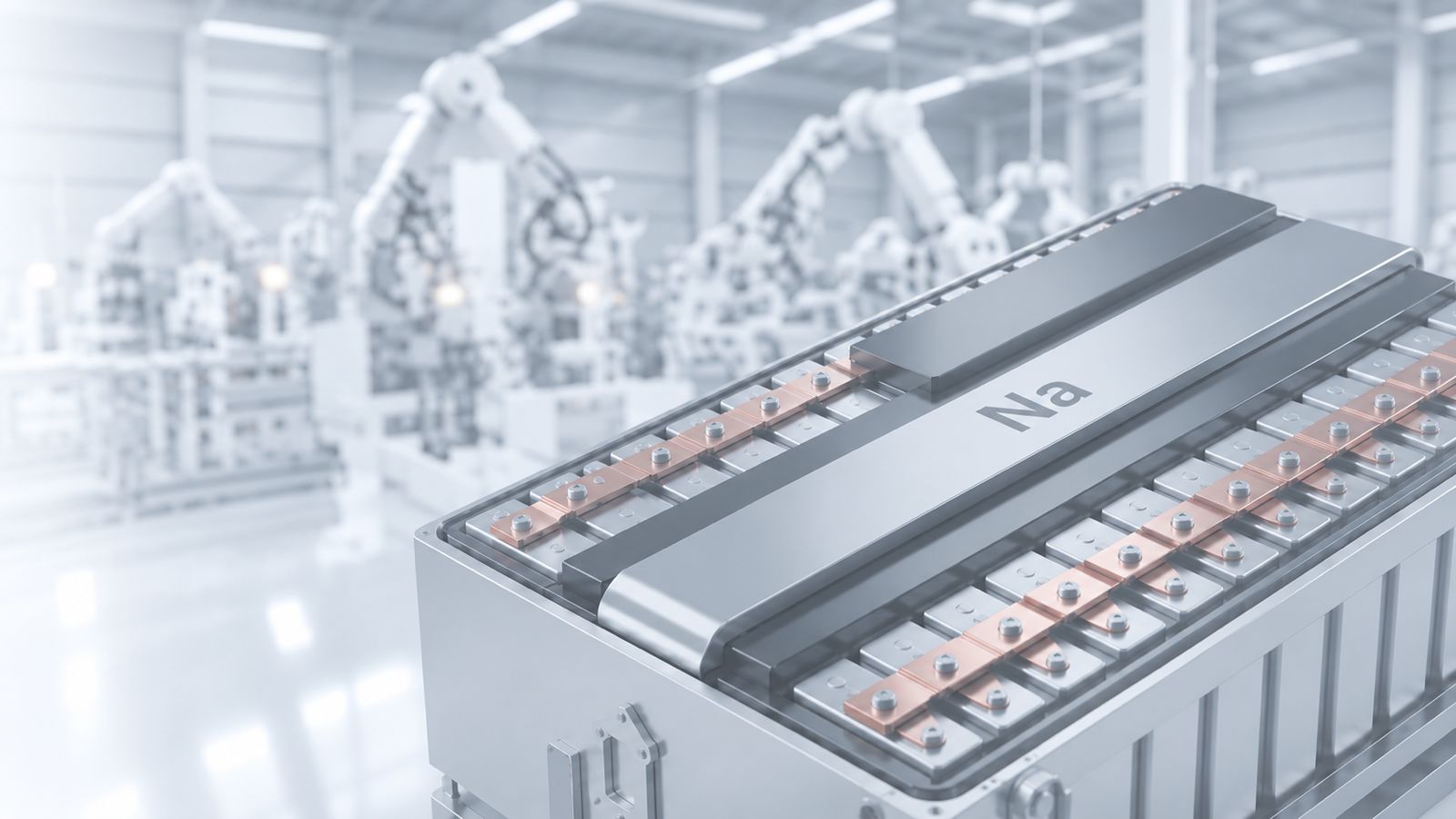
Sodium-ion cells use sodium as the charge-carrying ion. The technology is being developed across the industry as an alternative chemistry for selected energy-storage applications.
If you’re evaluating energy storage for your business, your infrastructure, or your portfolio, what ultimately matters is the system level — not just the cell chemistry. That’s why this site progressively documents the cell chemistry, module architecture, battery management, safety concept and system design used by Sodium Energy. Until the underlying project data is released, our language here stays deliberately non-quantitative. Unfamiliar terms are explained in the glossary at the bottom of this page.
Batteries from salt? More precisely, from sodium, which can be extracted from ordinary table salt or from soda ash. Early research into sodium-ion batteries dates back to the 1970s and 1980s — alongside early lithium-ion research. So this isn’t a new trend; it’s a decades-old alternative chemistry that is only now becoming industrially mature.
TECHNOLOGY COMPARISON
Sodium-ion chemistry takes a different safety and material approach than the lithium-ion systems that dominate today.
Sodium-ion cells contain no lithium, manganese, cobalt, graphite or silver — only sodium and carbon.
That lowers dependence on materials with documented environmental and human-rights risks — including child labor in cobalt mining — and on the few states that control access to them.
Raw materials other battery technologies depend on
A soft alkali metal; comparatively scarce in industrially minable concentrations, with extraction involving significant water use and environmental impact.
Batteries require high-purity, comparatively rare natural graphite; its mining and processing are heavily concentrated in China.
Economically mineable today mainly in the DR Congo, with documented environmental and human-rights risks, including child labor in artisanal mining.
Considerably more abundant than lithium or cobalt, though extraction still carries significant local environmental impact.
A precious metal with broad industrial demand across many applications — correspondingly scarce and expensive.
Lithium-ion remains the default for automotive uses with tight space constraints, thanks to higher energy density. Sodium-ion is gaining ground elsewhere — forklifts, golf carts, and increasingly commercial vehicles.
WHY SODIUM-ION
You don’t need to commit to a single chemistry. As your storage needs grow, you benefit from a market that offers more than one technically credible material system to choose from.
Sodium is widely available globally. That makes the chemistry strategically interesting where material accessibility and supply diversification matter.
Sodium-ion adds another electrochemical option alongside established storage technologies, allowing systems to be matched more closely to application requirements.
The technology is especially relevant to markets where cost structure, resource availability, safety engineering and stationary use are evaluated as a complete system.
Without lithium, cobalt, manganese or graphite, the cell chemistry is independent of the geopolitically concentrated supply chains behind those materials.
Because sodium supply isn’t concentrated among a handful of sanction-exposed producing states, sodium-ion storage carries a lower risk of politically driven supply disruption or monopoly pricing.
Sodium-ion cell chemistry is fundamentally more stable than lithium-ion — making sodium-ion storage the more resilient choice for safety-critical and crisis-prone environments.
SYSTEM PERSPECTIVE
A credible storage product depends on engineering at cell, module, rack, control and service level. Final specifications will be published only when validated.
Mechanical design, electrical topology and thermal strategy can be documented here once final system data is released.
Control logic, monitoring, protection functions and operating windows belong to the system specification rather than marketing shorthand.
Safety concepts should be explained through architecture, testing and operating conditions. No certification or safety claim is implied by this placeholder content.
Commissioning, diagnostics, maintenance and end-of-life strategy are integral to an industrial storage platform and will be documented as they are confirmed.
PRODUCT PORTFOLIO
The portfolio spans large-scale storage for critical infrastructure, modular compact storage, and utility-scale battery parks — all on a sodium-ion basis.
Large-scale storage for industrial customers, critical infrastructure and public institutions
The current generation is air-cooled and in service in the ~1 MWh power range.
Liquid-cooled and passive-cooled variants scaling to multiple megawatt-hours are in development.
Modular compact storage for industrial and private customers
The current generation is air-cooled and in service in the ~100 kWh power range.
Liquid-cooled and passive-cooled variants with higher capacity are in development.
Utility-scale storage solutions (10–100 MWh class)
Battery park deployments are in the implementation phase.
Expansion proceeds in stages together with network and distribution partners.
APPLICATIONS
01
Stationary storage concepts for businesses, facilities and industrial energy management.
02
Storage architectures intended to support the temporal balancing of renewable generation and site demand.
03
Future system variants may address grid-oriented applications subject to technical qualification and local market requirements.
MARKET & LANDSCAPE
Large-scale battery storage is among the fastest-growing segments of the energy industry. Sodium-ion is one of several technologies in the European competitive landscape.
A selection of other sodium-ion companies active in Europe. Based on our own market research, independently verifiable and presented without judgment:
Austria
Stationary sodium-ion storage, 1-2h duration, liquid-cooled.
United Kingdom
Sodium "solid state" cells, 5-12h duration; source indicates no market-ready product yet.
Netherlands
Stationary sodium storage systems, paired with PV only.
Spain
Developing proprietary sodium-ion cells and batteries; source indicates no market-ready product yet.
France
High-performance cells for automotive, power tools and stationary storage; EU production planned.
Sweden
Cell manufacturer focused on low-voltage automotive, stationary storage and select industrial applications.
Netherlands
Planned production of lithium-ion, solid-state and sodium-ion cells; source indicates no market-ready product yet.
FREQUENTLY ASKED
Direct answers to the questions that actually matter before you decide.
Safety is created by the whole system: cell chemistry, battery management, enclosure and installation together. Cell chemistry does play a big part. Even with the best battery management and enclosure, lithium-ion cell chemistry is inherently more dangerous than sodium-ion.
The core difference is raw materials: sodium-ion cells contain no lithium, cobalt, manganese, graphite or silver. That affects supply chain and material availability. See the Technology Comparison section for details.
This site provides information about technology and market trends and is not a public investment offer. If you’re interested in investment opportunities connected to Sodium Energy, let us know via the contact form — our team will follow up.
You’ll receive our information by email: a technology overview and an invitation to technology calls and a personal video call with our expert on opportunities in this field. Newsletters are sent only for new information, always with an unsubscribe link.
The global energy storage market was estimated at roughly USD 669 billion in 2024, projected to reach roughly USD 5.12 trillion by 2035 (source: BloombergNEF, gminsights.com). Sodium-ion is one of several technologies within that growing market.
Both are cell chemistries optimized primarily for safety and longevity rather than maximum energy density. The main difference is raw materials: LFP still requires lithium, while sodium-ion uses none at all — that affects material availability and supply chain, not necessarily every performance metric.
The EU Battery Passport is part of the EU Battery Regulation and, from February 2027, mandates digital product records and minimum recycled-material content for certain battery categories. It primarily affects stationary and industrial storage solutions with a high lithium share in their supply chain. Sodium-ion technology is inherently easier on the environment and simpler to recycle, since it avoids scarce, high-impact materials like cobalt and natural graphite. Because sodium and carbon are abundant, sodium-ion storage is also less likely to fall under the Passport’s strictest sourcing requirements, which target chemistries dependent on critical materials.
Data centers are classified as critical infrastructure and require uninterrupted power. Large-scale battery storage bridges short-term grid fluctuations or outages until backup systems take over — under particularly high safety requirements for the storage technology used.
INDUSTRIALIZATION
Industrial credibility depends on reproducibility, quality control, supply-chain discipline and serviceability — not on a prototype alone.
If you’re planning at the system level, a prototype isn’t enough — you want to know how reliably something is manufactured, tested and installed. We’re in active discussions with an industrial manufacturing partner. We’ll name them and share details once officially cleared for publication — until then, this section stays structured to host verified information about production stages, quality processes, rollout, installation and service.
Component sourcing and incoming quality
Cell, module and system manufacturing stages
End-of-line testing and traceability
Installation, commissioning and service concept
INFORMATION REQUEST
For project, technology or commercial information, use the form below. The final German and English Mautic form IDs can be inserted centrally in the content file.
sodium-energy.info
After submitting, you’ll receive our information package by email: technology overview and market data.
Submitting a Mautic form sends the entered information to the separately operated Mautic system at mautic.sodium-energy.info.
Interested in investment opportunities connected to Sodium Energy? Mention it in your message — we’ll offer you a free, non-binding information conversation and discuss your eligibility there.
WHO THIS IS FOR
This page is built for four groups — if you recognize yourself, it’s worth a closer look.
You’re evaluating large-scale storage for your business and want technology, safety and supply chain understood as one system.
You’re reviewing cell chemistry, system architecture and integration requirements in detail.
You need storage solutions suited to safety-critical sites.
You’re tracking how sodium-ion technology is developing and where it sits in the storage market.
GLOSSARY
Cell chemistry and regulatory terms, explained in plain language.