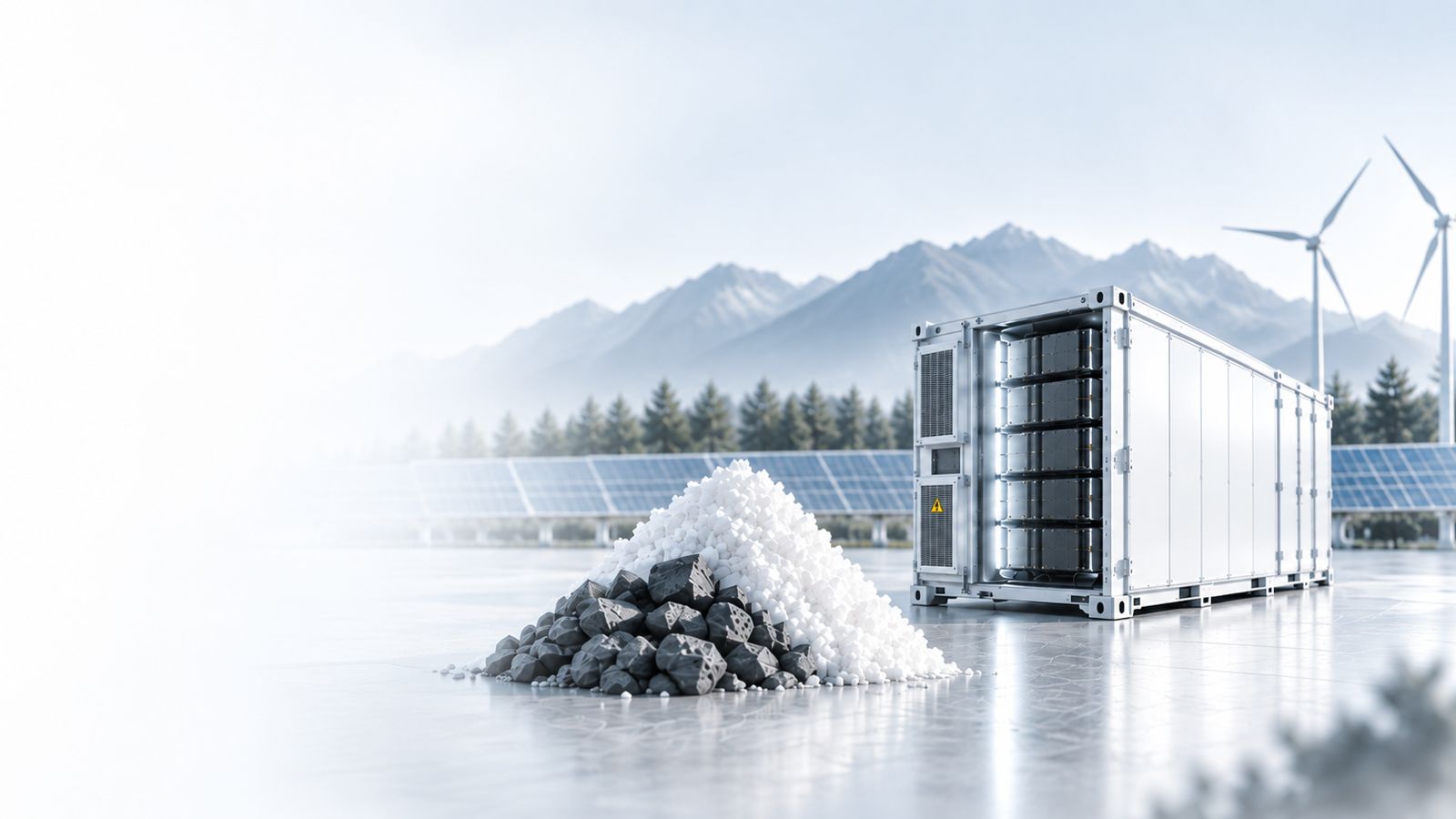
Abundant raw material base
Sodium is widely available globally. That makes the chemistry strategically interesting where material accessibility and supply diversification matter.
SHAPE THE ENERGY TRANSITION
Sodium-ion storage without lithium, cobalt or graphite. BESS Container (~1 MWh) and Cabinet (~100 kWh) are in service today – battery parks of 10–100 MWh are being implemented.
TECHNOLOGY
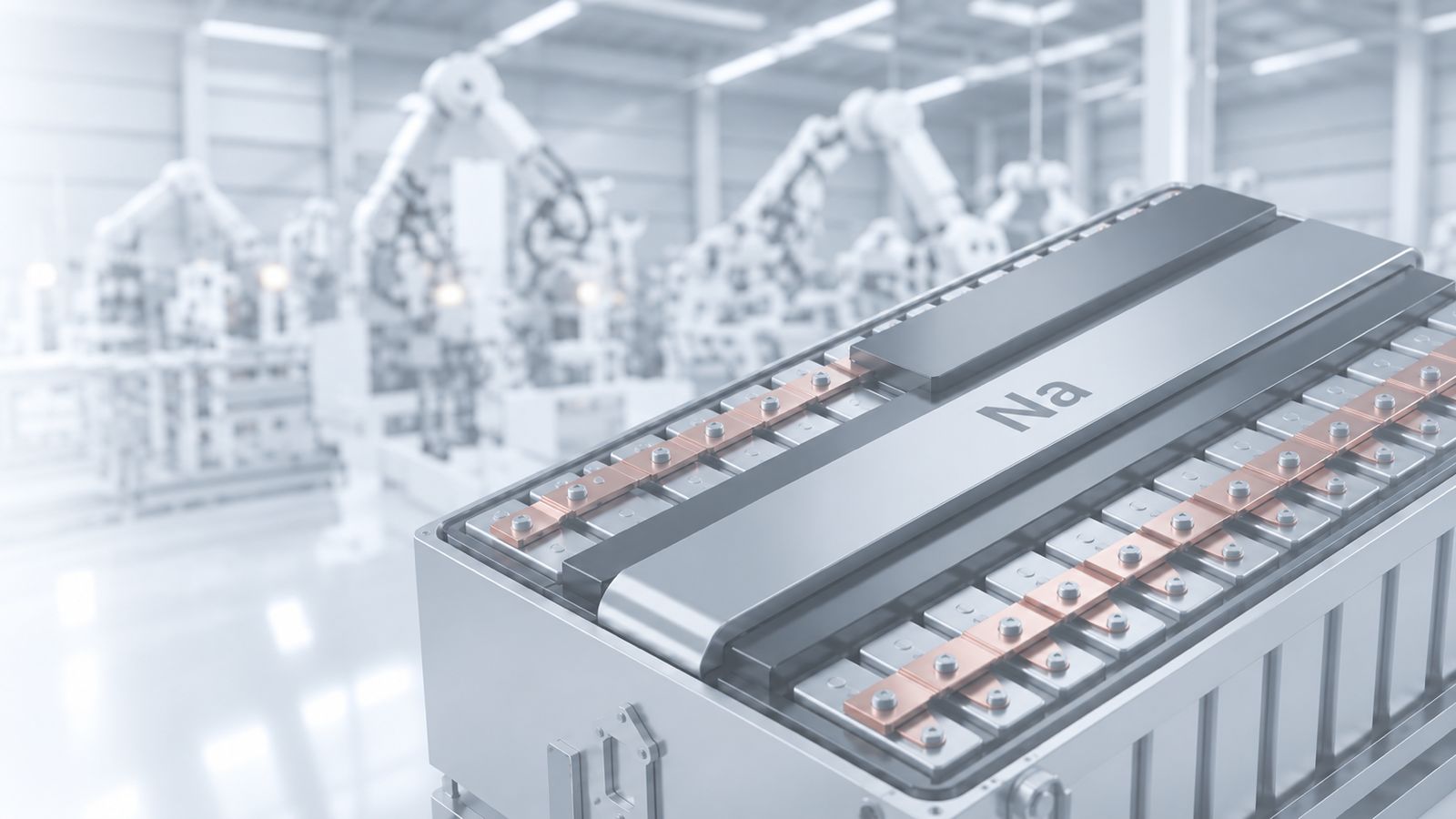
Sodium-ion cells use sodium as the charge-carrying ion. The technology is being developed across the industry as an alternative chemistry for selected energy-storage applications.
If you’re evaluating energy storage for your business or your infrastructure, what ultimately matters is the system level – not just the cell chemistry. How safe and reliable a storage system is in operation depends on how the cell, battery management, enclosure and professional installation work together. Those are exactly the layers we walk you through in the technical briefing.
Batteries from salt? More precisely, from sodium, which can be extracted from ordinary table salt or from soda ash. Early research into sodium-ion batteries dates back to the 1970s and 1980s – alongside early lithium-ion research. So this isn’t a new trend; it’s a decades-old alternative chemistry that is only now becoming industrially mature.
WHY SODIUM-ION
Sodium-ion adds another option alongside established storage technologies – especially where raw materials, supply chains and stationary use are the priority.
Sodium is widely available globally. That makes the chemistry strategically interesting where material accessibility and supply diversification matter.
Sodium-ion adds another electrochemical option alongside established storage technologies, allowing systems to be matched more closely to application requirements.
The technology is especially relevant where cost structure, resource availability, safety engineering and stationary use are evaluated as a complete system.
Without lithium, cobalt, manganese or graphite, the cell chemistry is independent of the geopolitically concentrated supply chains behind those materials.
Because sodium supply isn’t concentrated among a handful of sanction-exposed producing states, the risk of politically driven supply disruption is lower.
How safe a storage system is depends on the whole system: cell, battery management, enclosure and professional installation. That’s why we look at safety on all of these levels – not just at cell level.
PRODUCT PORTFOLIO
The portfolio spans large-scale storage for critical infrastructure, modular compact storage, and utility-scale battery parks — all on a sodium-ion basis.
Large-scale storage for industrial customers, critical infrastructure and public institutions
The current generation is air-cooled and in service in the ~1 MWh power range.
Liquid-cooled and passive-cooled variants scaling to multiple megawatt-hours are in development.
Modular compact storage for industrial and private customers
The current generation is air-cooled and in service in the ~100 kWh power range.
Liquid-cooled and passive-cooled variants with higher capacity are in development.
Utility-scale storage solutions (10–100 MWh class)
Battery park deployments are in the implementation phase.
Expansion proceeds in stages together with network and distribution partners.
APPLICATIONS
01
Stationary storage concepts for businesses, facilities and industrial energy management.
02
Storage architectures intended to support the temporal balancing of renewable generation and site demand.
03
Data centers and other critical infrastructure need an uninterrupted power supply. Battery storage can bridge short grid fluctuations or outages until backup systems take over.
REGULATION
The EU Battery Regulation (EU) 2023/1542 sets new rules for batteries placed on the EU market – including stationary energy storage.
For industrial batteries above 2 kWh – which includes stationary storage – a digital battery passport becomes mandatory from February 2027. It brings together information on composition, carbon footprint and recycling, among other things.
The regulation also sets supply-chain due-diligence obligations that cover cobalt, lithium, nickel and natural graphite, among others, as well as phased minimum shares of recycled material.
Sodium-ion cells work without lithium, cobalt or graphite. The regulation applies to them just the same – but the raw-material base is a factor planners and buyers can take into account when assessing supply chain and documentation.
General context only – not legal advice and not a statement of conformity for any specific product.
FREQUENTLY ASKED
Short answers to the questions that matter in a technical evaluation.
Safety is a property of the whole system: cell chemistry, battery management, enclosure and installation work together. Cell chemistry is one part of that. A reliable statement can therefore only be made for a specific system under defined operating conditions – which is exactly what we cover in the technical briefing.
The core difference is raw materials: sodium-ion cells use sodium as the charge carrier and contain no lithium, cobalt or graphite. That affects supply chain and material availability. For space-constrained uses such as automotive, lithium-ion remains the default for now thanks to its higher energy density.
Both are cell chemistries optimized primarily for safety and longevity rather than maximum energy density. The main difference is raw materials: LFP still requires lithium, while sodium-ion uses none at all – that affects material availability and supply chain, not necessarily every performance metric.
BESS Container (~1 MWh) and Cabinet (~100 kWh) are in service in their current, air-cooled generation. Battery parks of 10–100 MWh are being implemented. More under Products.
Data centers are classified as critical infrastructure and require uninterrupted power. Large-scale battery storage bridges short-term grid fluctuations or outages until backup systems take over.
We’ll email you the technical briefing. If you like, we can also arrange a technology call or a video call with our team – we’ll agree the time with you individually.
Request the technical briefing – we’ll get back to you by email.